When someone calls and says their car is shaking, the first question back is never “what does it feel like.” It is “when does it happen?”
A shake at a stoplight and a shake at 65 mph on Highway 37 come from opposite ends of the vehicle. That one answer rules out most of the possibilities before anyone opens the hood. Two more finish it: “Where do you feel it” and “does it change when you brake?”
We are writing the sequence out because the alternative is common, and from the customer’s side it does not look like bad service. It looks like a shop that tried three different things.
So here is the stance: the most common vibration we see is not a repair, and the second most common one is free. Balance issues and packed snow, in that order. A guide organized as a list of failing components will never tell you that, because a list of parts is a list of things to sell.
• In the steering wheel: if the steering wheel shakes when driving, it is usually an issue in the front tires, front wheels, front brakes, or a front suspension component.
• In the seat or the floor: usually the rear tires and wheels, or the driveline.
• In the brake pedal, only when braking: the brakes themselves.
• Through the whole vehicle while stopped: the engine, not the wheels.
A shake that is worst while sitting still and smooths out once you are moving points at the engine, not the wheels. The usual causes: a cylinder misfiring, worn spark plugs or coils, a vacuum leak, or a collapsed engine mount that has stopped absorbing the vibration an engine normally makes.
If it comes with a check engine light, the stored codes usually name the cylinder. Engine diagnostics turns this into a short conversation instead of a guess, which is the difference between a diagnostic fee and a parts bill.
Can you keep driving? A rough idle with a steady check engine light is generally a schedule-it-soon item. A flashing check engine light is different. Raw fuel is reaching the catalytic converter, and continuing to drive turns a casual repair into a bigger one.
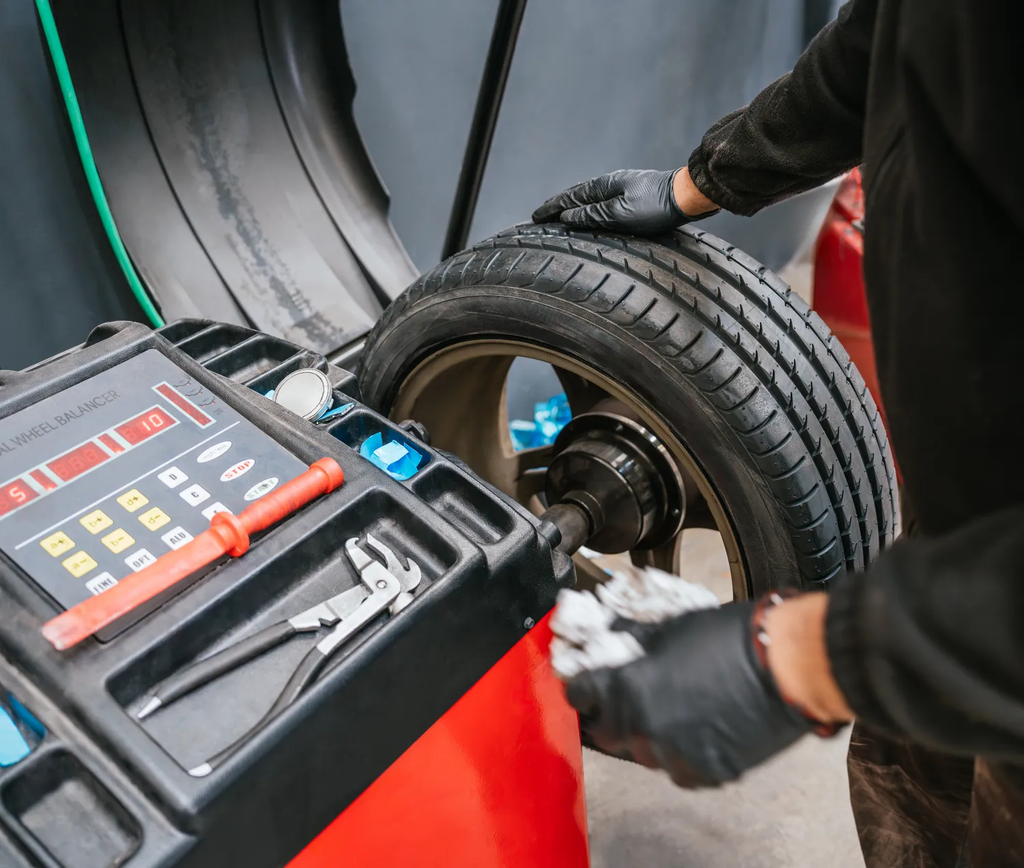
This is the one we see most, and it is usually the least serious. A shake that appears in a specific speed range and smooths out above or below it is the signature of a wheel or tire that is no longer balanced.
• A wheel weight thrown off on a pothole
• A wheel bent slightly out of true, common after a hard hit on a winter street
• A tire wearing unevenly, often because alignment has drifted
• A tire with internal belt separation, which looks fine from the outside
A rotation and balance often resolves the whole complaint. Here is the part worth knowing. If the tires themselves are worn unevenly, balancing hides it for a few weeks and it comes back. A shop can sell that same balance three times in a season and never be technically wrong.
Can you keep driving? Usually yes, if it is steady and has been there a while. Have it looked at before a long trip, and sooner if it is getting worse week over week.
A vibration that appears when you accelerate and disappears when you accelerate means something is loading up under torque. The usual suspects are a worn CV axle, a failing engine or transmission mount, or a misfire that only shows itself under load.
Can you keep driving? It would be a bad idea to keep driving, because a CV axle that is clicking and shaking is on a path to failure, and the repair gets more involved the longer it runs that way.
If your car shakes when braking, and the shake is a pulse through the pedal or a shimmy in the steering that shows up only while slowing down, it almost always comes from the brakes. Usually uneven rotor thickness, or pad material transferred unevenly onto the rotor face. A sticking caliper does it too. That one arrives with a burning smell and one wheel noticeably hotter than the others after a drive.
Can you keep driving? If the pedal pulses but the vehicle stops normally, schedule a brake service. If the pedal is going soft, going to the floor, or the vehicle pulls hard to one side when you brake, stop driving it and call us.
A vibration or shudder that appears mid-corner and goes away when you straighten out usually points at a CV joint or a wheel bearing. A bearing often announces itself first with a hum that rises with speed, weeks before any vibration appears.
Can you keep driving? Have it inspected soon. A wheel bearing that has started to fail is one of the few items on this page that can fail suddenly, and it is the reason we do not tell everyone their car’s shaking can wait.
At idle, smooths out when moving → misfire, spark plugs, vacuum leak, engine mount · *schedule soon*
Appears at 45 to 60 mph, felt in the steering → front tire or wheel balance, bent wheel, alignment · *usually can wait, but not long*
Appears at speed, felt in the seat → rear tire or wheel, driveline · *usually can wait*
Only under acceleration → CV axle, mount, misfire under load · *schedule soon*
Only when braking → rotors, pads, sticking caliper · *schedule ASAP; stop driving if the pedal is soft*
Only when turning → CV joint, wheel bearing · *inspect promptly*
Sudden, severe, or with a warning light → stop driving and call us
We will not replace parts to see what helps. Jarred Mason, who owns the shop and still works the floor, puts it this way:
“You can throw parts at a vibration until it goes away. It works eventually. The customer pays for every guess in between. We’d rather measure it and show you the number.”
What we do: the three questions, then a road test to reproduce it, then measurement on the lift. A balance reading, a rotor measurement, a misfire code. If we cannot show you the reason, we have not finished diagnosing it.
The three buckets we use at the service desk, in plain terms:
• Stop driving: it came on suddenly, it is severe, it arrived with a warning light, or the brakes or steering feel different than they did yesterday
• Schedule it soon: consistent, predictable, and nothing about how the vehicle stops or steers has changed
• Mention it at your next service: mild, one narrow speed range, unchanged for months
Most vibrations land in the middle bucket. A shop that treats all three the same is not doing you a favor, and one that puts everything in the first bucket is selling urgency.
Every winter we take calls about a vehicle that started shaking the morning after a storm. Nine times out of ten it is packed snow, ice and salted slush frozen to the inside of a wheel, which is enough weight to throw that wheel out of balance.
It clears itself once things thaw and it costs nothing, and we will say so on the phone rather than book the appointment. If the vibration is still there a few days later on dry pavement, it earns a look. A hard hit on a snow-hidden pothole is the other thing that happens around here in February.
This is the kind of answer that does not exist on a page written to sell a diagnostic.
Across over 300 Google reviews and 79 verified CARFAX reviews, the two things our customers describe most often are honesty and being told plainly what needed doing and what could wait. A vibration is where that gets tested, because it is the symptom most easily turned into a long list of parts.
Our technicians are ASE-certified and knowledgeable across both domestic and import work, with Ford Master Technician credentials, Subaru factory training and GM AC-Delco certification. Every visit includes a complimentary CarFax report, and the work is backed by a 2-year, 24,000-mile nationwide warranty.
You get fair pricing and an estimate that matches the invoice. We are a local shop your neighbors already recommend, at 2111 S Yost Ave, Monday through Friday, 8 to 5, with after-hours drop-off and pickup if a vibration is not something our schedule can work around.
Why is my car shaking, and is it safe to drive?
It depends on when the shake happens and whether it is new. A sudden shake, a shake with a warning light, or any change in how the vehicle brakes or steers means stop driving. A steady highway-speed vibration you have had for weeks is usually a balance issue, and can often wait for an appointment.
Why does my car shake when I brake?
Uneven rotor thickness or uneven pad deposits, most of the time. If the shimmy is in the steering wheel rather than the pedal, it is usually the front rotors.
Why does my car shake when I accelerate?
A lost weight, a bent wheel or a tire wearing unevenly shows up in one range and smooths out on either side of it. Be extra careful if the car vibrates at high speed, and schedule a checkup.
Why does my car shake when parked but drive fine?
That is an engine question, not a wheel question. Misfire, worn spark plugs, a vacuum leak, or an engine mount that has given up.
How do I know this repair is actually necessary?
Ask us to show you the measurement. If we cannot produce a number, you should not authorize the part. That applies to us as much as to any other shop.
Can you diagnose it if it is not happening while you have the vehicle?
Often, yes. The wear that causes it is still measurable when the vehicle is sitting still. Tell your service advisor exactly when it happens, and if it only shows up on the highway say so, that is a road test rather than a shop test.
Can a bad tire cause shaking even if the tread looks fine?
Yes. Internal belt separation is invisible from the outside and shows up as a vibration long before anything looks wrong. It is one of the reasons we spin all four tires rather than eyeballing them.
Three questions, a road test, a measurement, then a conversation. You get an honest read on what we found, what your options are, and which of them can wait.
Ready when you are. Book online in under two minutes, or call (812) 27