We turn down filter work several times a day.
Someone comes in for something else, we check both air filters as part of our complete vehicle inspection, and one of them still has some life in it. That is a line item we could have sold and did not, and we would rather explain why than quietly add it to the estimate.
The reason is that the two filters in your vehicle are similar parts, but far different in function, and the industry treats them as if they are the same thing. One protects your engine. The other cleans the air you breathe. They fail differently, they matter differently, and in our experience drivers replace the wrong one on the wrong schedule almost every time.
So here is our position: the cabin air filter is a job most people change regularly, and the engine air filter is the one that quietly gets ignored for years. The rest of this blog explains why.
Jarred Mason, who owns the shop, ASE-certified and still works the floor, puts a number on it:
“We tell somebody their filter is still good 10 times a week. It’s thirty dollars we skip charging. That’s the cheapest way to show you how we’ll handle all parts of your car.”
Search the question, and you get an interval: 12,000 miles, 15,000 miles, once a year. Those numbers are real, and they come from the factory maintenance schedule for your vehicle.
A maintenance schedule is written for a fleet of identical vehicles driven under assumed conditions. It has to cover the person on gravel roads and the person doing highway miles with the same sentence, so it lands somewhere in the middle. That is the correct way to write a schedule, but a poor way to decide what your vehicle needs this week.
We use the schedule as a trigger to look, not a trigger to replace. Those are two different things, and the difference is the entire argument of this page.
The engine air filter sits in the airbox under the hood. Every bit of air your engine burns passes through it first, and its job is to keep dust and grit out of the intake and off the mass airflow sensor. This is the one we care about, because when it fails badly it stops being a filter and starts being a path for grit.
The cabin air filter usually sits behind the glovebox, or under the cowl at the base of the windshield. It filters the air coming through your vents: dust, pollen, mold spores, road grime. It has nothing to do with how your engine runs.
Which leads to the sentence most shops will not put in writing: a neglected cabin air filter will not damage your vehicle. It will weaken your air conditioning and make your vents smell musty. Those are real reasons to change it, however they are not urgent ones, and urgency is often what gets put behind the price tag.
On most vehicles, a cabin air filter replacement is this: the glovebox drops down, the old filter slides out, the new one slides in with the airflow arrows pointing the right way. Five minutes, no tools, and the filter itself runs $15 to $40.
We will still do it while your vehicle is with us, and the labor is minimal because we are already there. But if you would rather save that money, that’s one of the best ways.
The exception is the vehicles where the cabin filter sits under the cowl instead of behind the glovebox. Those take real disassembly, and if yours is one of them we will tell you that before you go looking for a video. An engine air filter replacement is usually just as simple, with one caveat we get to below.
As for how often to change your cabin air filter: the published range is every 15,000 to 25,000 miles, or once a year, depending on your driving conditions. Treat that as the point where you look into it, not the point where you go buy one.
You don’t need a certain mileage to know this one needs replacement. It tells you:
• Weaker airflow at the same fan setting, most noticeable on high
• A musty smell for the first few seconds after the fan comes on
• Defrost taking longer than it used to to clear the glass
• Allergy symptoms that are worse inside the vehicle than outside it
• A whine or whistle from the blower working against the restriction
Every one of these symptoms are noticeable from the driver’s seat, which is another difference between this filter and the engine air filter, and why this service should be skipped unless asked for by the customer.
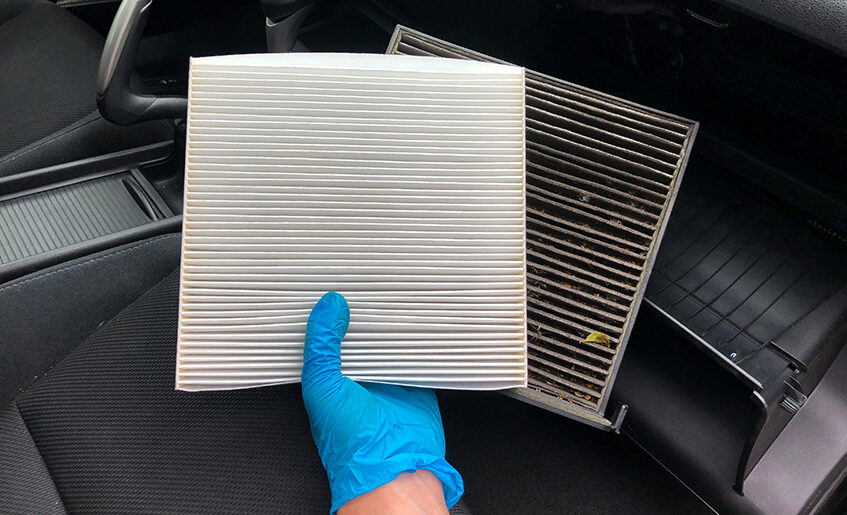
The engine air filter rarely gets replaced too often. It gets forgotten, because nothing about a clogged one is dramatic.
Modern engines compensate well. Airflow drops, the computer adjusts, and there is never a moment where something obviously goes wrong. What you get instead is fuel economy wearing down over months, and nobody really books appointments for that. Jarred explains:
“I’ve pulled filters out of cars around here that hadn’t been touched in sixty thousand miles. Packed solid with limestone dust. Nobody ever came in complaining about it. They just thought the car got older.”
That last part is the whole reason we check it during inspections instead of waiting to be asked.
It usually shows up as a fuel trim reading during engine diagnostics before it shows up in the driver’s seat. The complaint arrives late, if it arrives at all.
The failure worth caring about is not a dirty engine air filter. It is a filter that is torn, oil-soaked, or seated slightly wrong, because then unfiltered air carries grit straight past it. A badly installed filter is worse than the dirty one it replaced, and that is the reason we don’t treat the airbox as a five-minute job on every engine.
The published range is every 15,000 to 30,000 miles. That is wider than it looks, because this is the filter that is affected by driving conditions.
Since the symptoms are unreliable, here is what a late one looks like anyway:
• Fuel economy drifting down without any change in how you drive
• A soft spot or hesitation when accelerating
• A rough idle that was not there before
• Visible debris in the airbox when you open it, not just dust on the filter
If you are asking how often you should change your air filter and you want one answer for both: look at both filters once a year, and then you decide. That is the whole method, and it beats any interval we could print.
Engine air filter. Open the airbox, lift the filter out, hold it up to a light. If light passes through, it is still working. An even gray dusting is normal. If light will not pass, if the pleats are packed, or if it feels oily, replace it. Tapping loose dust out is fine, just don’t wash it as that will ruin the filter.
Cabin air filter. Slide it out from behind the glovebox and look at the inlet side. Leaves, seeds and a gray felt of packed dust mean it is done.
We are telling you how to check them because a customer who can check is a customer who cannot be sold a filter they do not need, including by us.
This part is local, and it is the part a national page cannot write for you.
Shorter interval:
• Gravel and unpaved county roads. Limestone dust is hard on an engine filter, and there is a lot of it south of town
• Spring pollen in southern Indiana, and any stretch under construction
• Stop-and-go driving with the fan running most of the time
• Parking under trees, which packs seeds and needles into the cowl intake
• Pets in the vehicle, or anyone in the household with allergies or asthma. The comfort threshold is simply lower
Longer interval:
• Mostly highway miles on paved roads
• A garage-kept vehicle
• Low annual mileage with one caveat. A cabin filter degrades with humidity and time, not only miles. At 6,000 miles a year it still needs a yearly checkup.
Because the filter is not the transaction. The next repair is.
Over 300 Google reviews and 79 verified CARFAX reviews, the word our customers reach for most often is honest, and the second most common thing they describe is someone taking the time to explain what needed doing and what could wait. Almost none of those reviews are about a big job. They are about the small moments where nothing got sold.
Our technicians are ASE-certified and knowledgeable across domestic and import work, with Ford Master Technician credentials, Subaru factory training and GM AC-Delco certification. Every visit includes a complimentary CarFax report, and the work is backed by a 2-year, 24,000-mile nationwide warranty, whether you’re coming in for a routine oil change or need a more complex service.
You get fair pricing, an estimate that matches the invoice, and a local shop your neighbors already recommend. We are at 2111 S Yost Ave, Monday through Friday, 8 to 5, with after-hours drop-off and pickup for anyone whose schedule does not fit ours.
Engine air filter, every 15,000 to 30,000 miles. Cabin air filter, every 15,000 to 25,000 miles or once a year. Both numbers are inspection points, not purchase points.
Every 15,000 to 25,000 miles, or once a year. Gravel roads, pollen season and constant fan use pull it shorter; highway miles and a garage push it longer. And you will usually smell it before you hit the number.
Every 15,000 to 30,000 miles, and this is the one where your roads matter most. Limestone dust and unpaved county roads can take years off that range.
Your engine is fine. Airflow drops, defrost gets slower, and the vents start to smell. It is a comfort part, not a required fix, so if you want us to change it then we will, but we won’t try and sell you on it.
A dirty one mostly costs you fuel and throttle response. A torn, oil-soaked or badly seated one is the real risk, because it lets grit past the filter entirely. That distinction is the whole reason installation matters more than interval.
A cabin air filter replacement runs $15 to $40 for the filter itself. The variable is access, minutes on most vehicles, real disassembly on a few. We tell you which one yours is before we start.
No, and bundling them is the most common way this gets oversold. They wear at different rates for different reasons. We will tell you when only one of the two is actually due.
You can tap loose dust out of a paper engine filter if the pleats still pass light. Do not wash it, because the filter is a paper-like material and it will ruin it.
Yes, and this page exists partly so you can hold us to that.
Time matters more for the cabin filter. Humidity and organic debris do their work whether you are driving or not, and a vehicle parked outside near campus for a semester collects plenty of both. The engine filter can go by mileage.
We check both filters during service visits and inspections, we show you what we found, and we tell you which of them can wait. Sometimes both can. That is a real outcome here, not a slogan.
Ready when you are. Book your service online in under two minutes, or call us at (812) 272-7540.